
Greenland 2026: Jernej Kruder and the First Ascent of Sila
For Jernej Kruder, the summer of 2026 was not supposed to be about chasing another extreme climbing grade. Instead, he was looking for something different: a journey where uncertainty, exploration and the landscape itself would be just as important as the climbing.
Greenland offered exactly that.
What began as an invitation from Swiss friends soon turned into a full Arctic adventure involving a tiny Zodiac, hundreds of kilometres of coastline, delayed flights, rough seas, heavy packs, glaciers, relentless rain and walls that were far wetter and more intimidating than expected.
With time running out and the original objective no longer realistic, the team changed plans. A wall they had noticed from the fjord became their new target.
During a brief spell of favourable weather, they established a new route and reached an unclimbed summit. They called the route Sila.
Choosing Adventure Over Hard Climbing
At the beginning of summer, my shoulders were not in the condition I wanted them to be for hard climbing in the Alps. I had already taken a few days off to enjoy the good weather, but I was still trying to decide what kind of trip would make sense.
Friends from Slovenia invited me on an expedition to Kyrgyzstan. At almost the same time, a group of Swiss friends offered me the opportunity to join them in Greenland.
Greenland immediately caught my attention. I wasn’t searching for a trip where climbing at my absolute physical limit would be the main objective. I wanted something more exploratory—a place where reaching the wall could be an adventure in itself. When I found a good flight connection, the decision was easy. I booked the ticket.
Into Southern Greenland by Zodiac
Silvan, who was leading the expedition, had already shipped a small Zodiac with a 20 HP engine to Greenland. His plan was ambitious: use the boat to travel roughly 230 kilometres from Qaqortoq towards our climbing area.
There were originally five of us, which was clearly a lot of people and equipment for such a small boat. Because of that, I had arranged to travel part of the journey by ferry to Aappilattoq.
Greenland, however, quickly reminded us that plans there are temporary. Our flight arrived late, Benji became seriously ill and the weather deteriorated. Instead of immediately heading into the fjords, we spent several nights waiting in Qaqortoq.
Eventually, Benji had no choice but to return home. His departure meant there was now enough room for me in the Zodiac. All we needed was a break in the weather.
During one of the few reasonable days, Silvan and I went bouldering close to the hostel. Then, after four days of waiting, the sea finally became calm enough for us to leave. Our first major destination was Nanortalik, approximately 180 kilometres away. It took the entire day.
We spent around eight hours travelling in the Zodiac, with a welcome three-hour break at hot springs along the way. By that point we were cold and exhausted, so a burger and some time in warm water felt unusually luxurious. That evening, we slept in our tents.
Rough Seas and an Unexpected Lift
The following morning brought rough water again, making further travel impossible. We spent another night in Nanortalik and squeezed all four of us into a tiny room intended for two people. While waiting, we met a group of Americans travelling by sailboat in the same direction.
Their route gave us an idea.
If two of us could travel with them, the Zodiac would be significantly lighter and safer. We asked, and they generously agreed.
The next morning, Filippo and I boarded their sailboat. It was slower than the Zodiac but infinitely more comfortable. After arriving in Aappilattoq, we said goodbye to our new friends, regrouped and immediately continued towards our final destination. Another 20 kilometres and roughly two hours later, we finally arrived. We established base camp and went straight to sleep.
A Long Approach to the Original Objective
The weather continued to dictate the expedition.
Another day disappeared at base camp while we waited, fished and organised equipment for the approach. At least the fishing was successful: Arctic char with rice became our fuel for the next day’s mission. The wall we originally wanted to climb was far from camp.
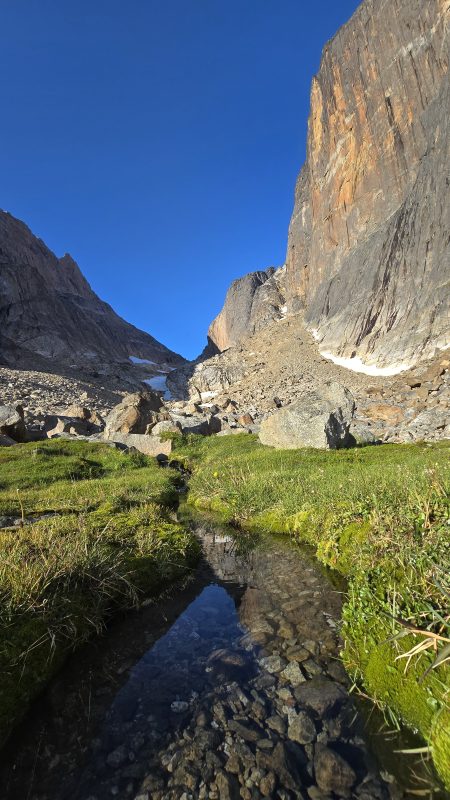
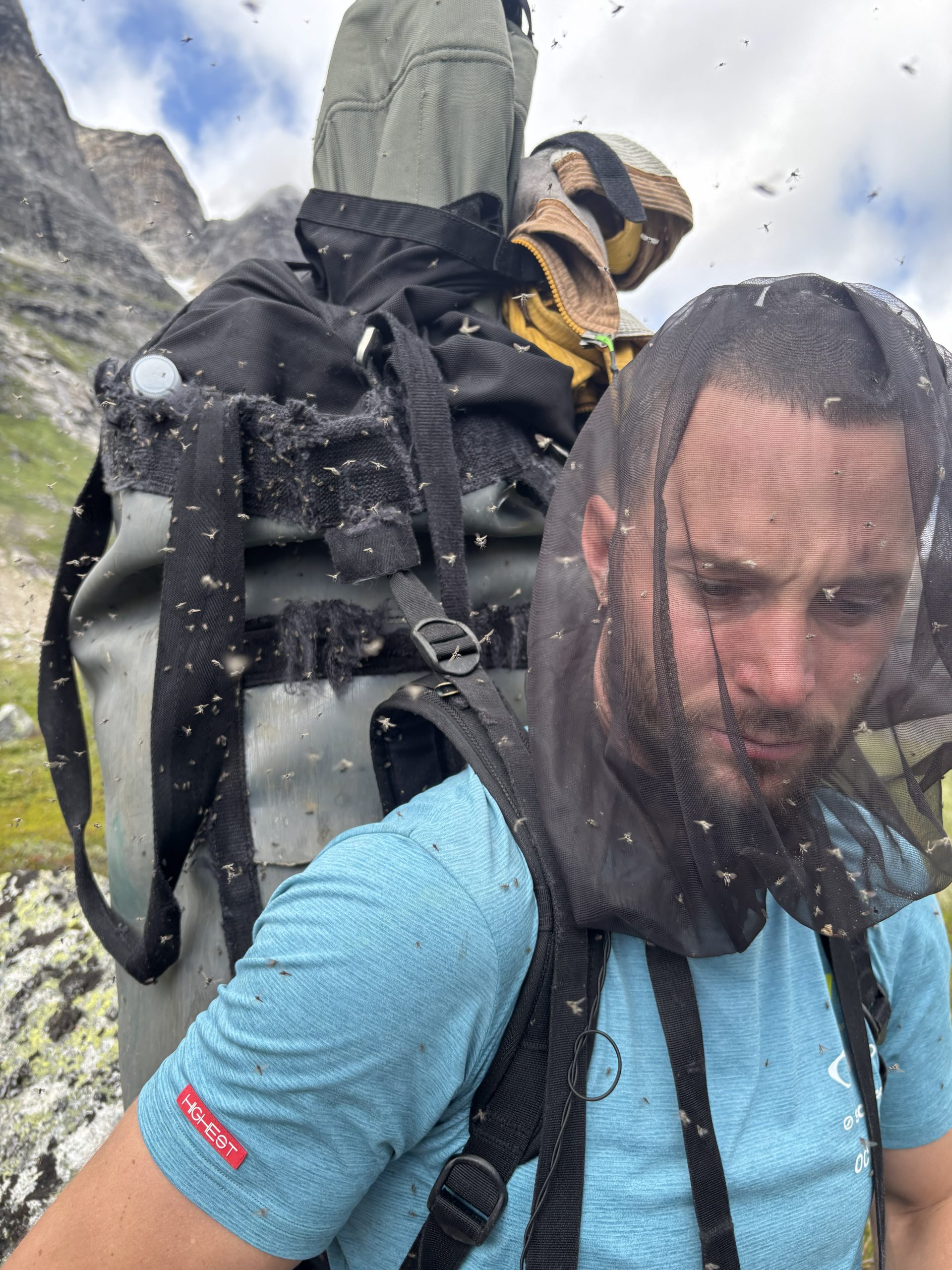
Reaching it meant around six hours of carrying 25-kilogram packs through wet vegetation, bushes, swamps and slippery terrain. By the time we reached the glacier, we had little energy left.
We installed our portaledges near its edge and slept.
From there, the wall looked incredible—but also worryingly wet.
The following day we continued across the glacier, tied together and carrying all our equipment. After another three hours, we found an excellent bivouac site.
Then the weather closed in again. The rain and poor conditions refused to leave, and eventually it became obvious that continuing with the original objective was no longer sensible. For me, there was another problem: I only had four days left.
We needed a new plan.
A Wall in the Fjord
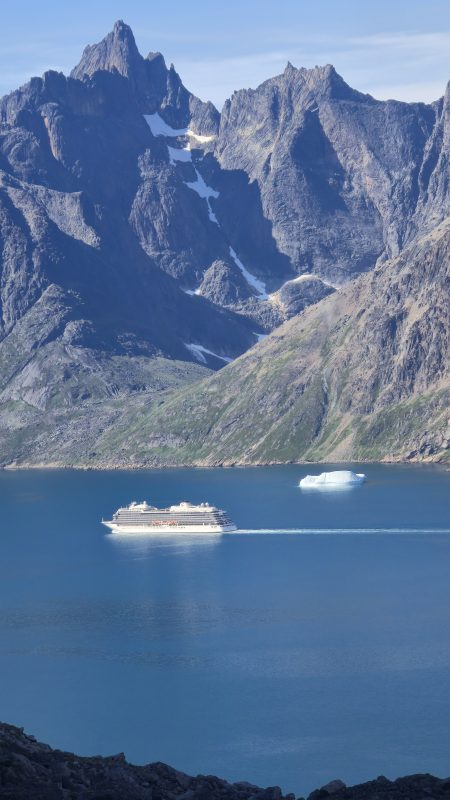
Fortunately, during our boat journey we had noticed another impressive wall in the last fjord we had passed. It suddenly became our best option. First, however, we had to get back down.
The descent turned into one of the most exhausting approaches I can remember. There were no trails. Everything was wet. Temperatures were low, rain seemed endless and our backpacks were still brutally heavy. By the time we reached shelter, I felt completely empty.
We climbed into our sleeping bags with soaked clothes and exhausted bodies and fell asleep almost immediately. During the night, the sound of a nearby rockfall woke us.
There was little time to think about it in the morning. We needed to pack quickly enough to use the high tide. For once, the weather gave us something back. Sunshine and wind helped dry our equipment, and our motivation returned almost as quickly.
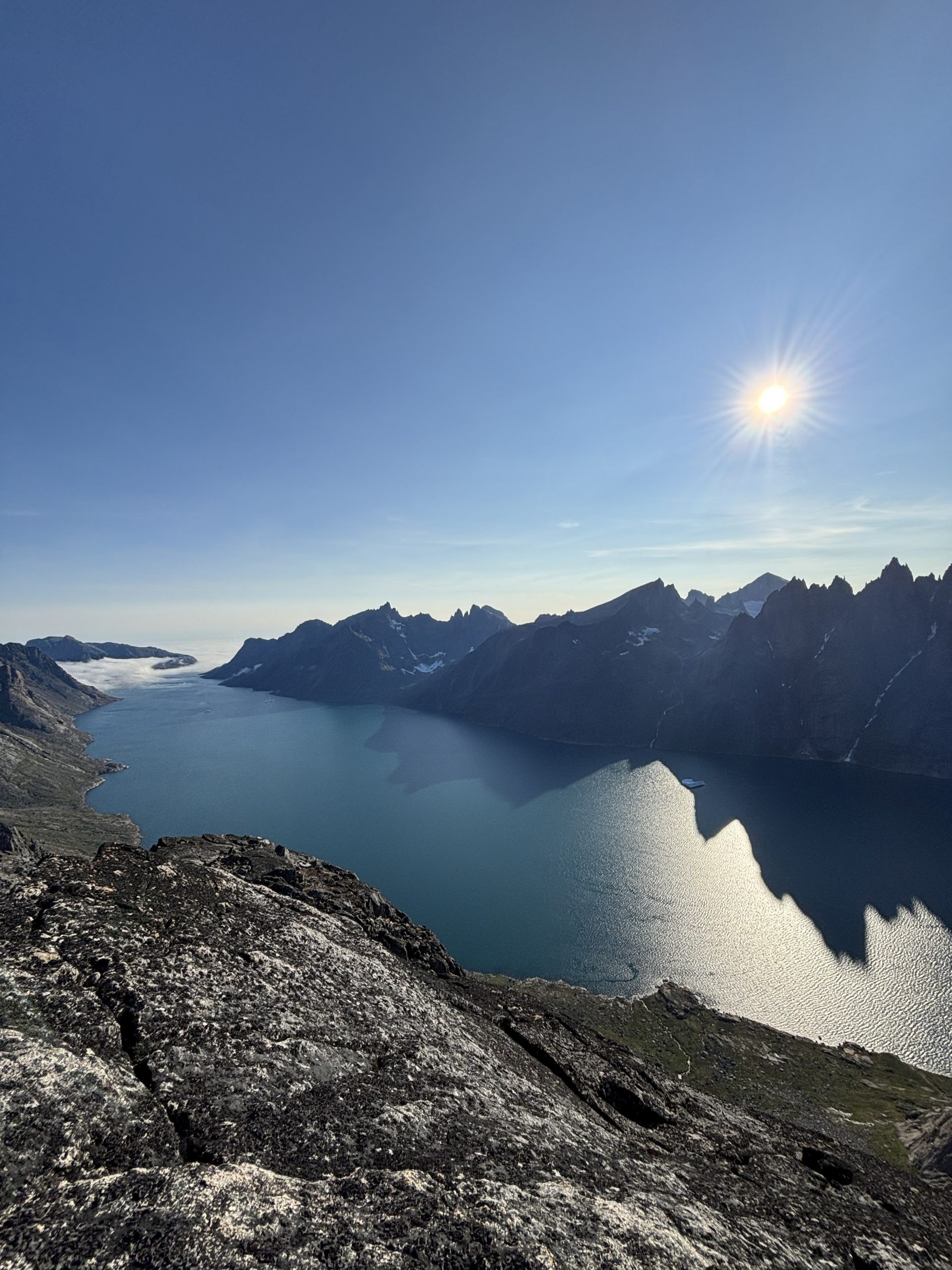
The sea was calm as we travelled towards the wall we had seen earlier.
When we arrived, we dragged the Zodiac onto a beautiful beach directly beneath a massive, steep face. It was an incredible place for a camp. We ate dinner looking up at our new objective. The next morning, it was time to climb.
Day One: Finding a New Line
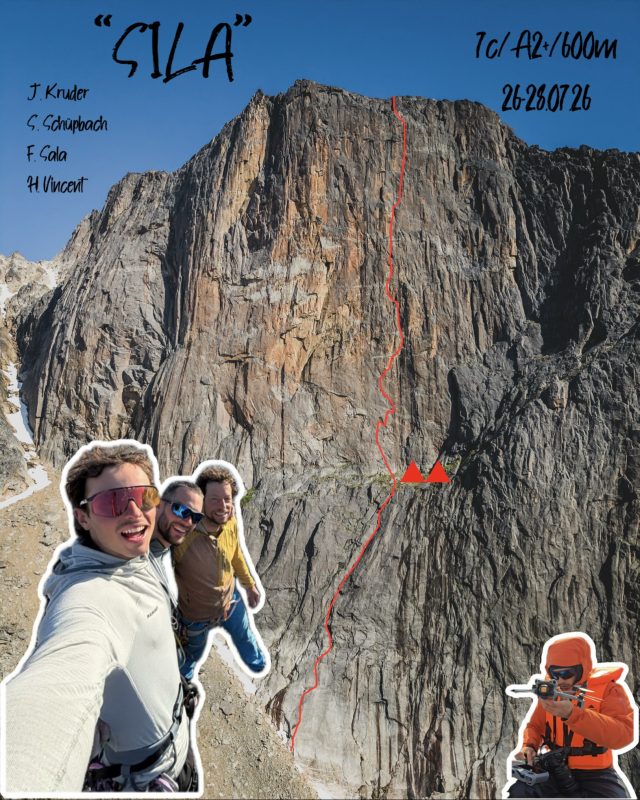
On July 26, a straightforward 45-minute approach brought us to the bottom of the wall. I started on lead immediately. The opening pitch followed slabs and dihedrals towards a ledge, where the climbing became more serious. Lower on the wall we encountered an existing belay, so rather than following the same terrain, we searched for an independent line across the main face. I continued upwards.
One pitch was technically no harder than around 6c, but the quality of the rock made it much more memorable than the grade suggests. Loose and unreliable holds quickly produced a serious case of disco knees. While Filippo prepared a flatter area on the ledge for our tents, Silvan and I continued establishing the route. Silvan eventually took over the lead, but halfway through one pitch he decided the upper section was better suited to me. He knew I would probably be willing to continue without adding a bolt.
He was right.
What followed was a long, committing runout across a fragile slab. The climbing was probably somewhere around 7b to 7c, but the difficulty was only part of the challenge. Staying calm on uncertain rock with protection far below required everything I had mentally. Eventually, I reached a position where I could establish an anchor for the static rope. That was enough for the first day. We descended to camp.
Day Two: Slow Progress on Difficult Ground
Thanks to Greenland’s long summer daylight, there was no reason for an excessively early start. On the second day, Filippo and I headed back onto the wall. We jumared the fixed ropes to our previous high point, where Filippo began the next pitch. It quickly became another serious lead.
His available protection was poor, and before committing to a traverse across the slab, he decided that adding a bolt was the sensible option. Following the pitch, I managed to climb the section free and then continued into a natural crack system. I established an uncomfortable, almost hanging belay and spent the next four hours there while Filippo fought his way through a hollow and difficult pitch. When it was my turn, I couldn’t free the same section.
Above us, however, the character of the route began to change. We reached a clear crack system that appeared to continue towards the summit. I led another two pitches. Despite the effort of the day, we were still not halfway up the main wall when we stopped. The final push would have to be fast.
The Summit Push
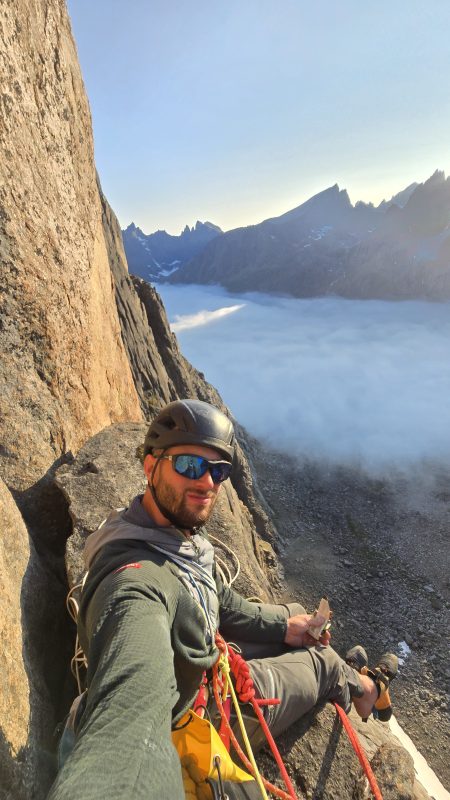
After sleeping on the ledge, we started early and jumared the fixed lines back to our high point. Silvan took over and began leading a sequence of logical and beautiful cracks. This was exactly the kind of climbing we had hoped to find. We managed to free all of the pitches, and I had the opportunity to lead one of the best sections myself. Hour after hour, the summit slowly came closer. Then we reached the second-to-last pitch. It became a major battle for Silvan.
Finding reliable protection took time, and many of the cracks needed cleaning before they could be used. From below, listening to him describe how hard the pitch felt did very little for my confidence about trying to free it afterward. Still, he encouraged me to give it everything.
The pitch required a different solution for almost every difficult section, but somehow I managed to put everything together and climb it free. Only the summit remained.
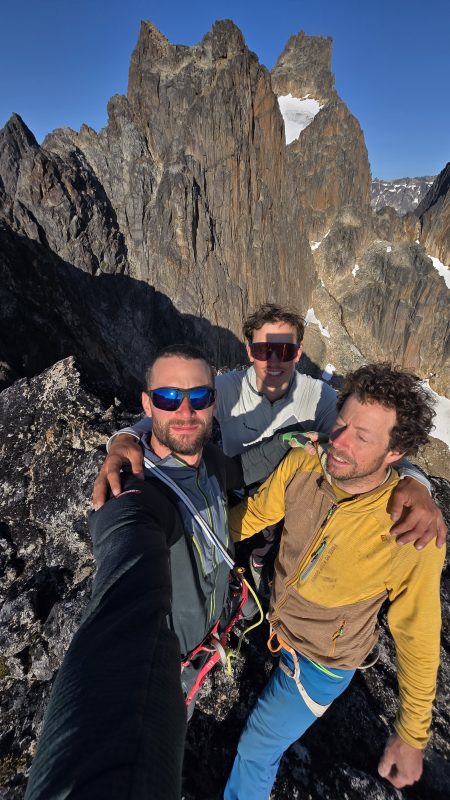
At 19:30, we stood on top.
There was no time for a long celebration. We ate something quickly, took in the surroundings and began rappelling back down the route. We stopped occasionally for photos and video, knowing that this was a moment we would want to remember. Eventually, without headlamps, we made our way back towards camp.
At around 01:00, we finally crawled into our tents.
From the Summit Straight Back to Civilization
Our successful first ascent did not earn us much rest. High tide was at 7:00 the following morning, and I needed to leave if I wanted to catch my ferry back towards Qaqortoq. I said goodbye to my Swiss teammates, who still had several days left in Greenland, and began the journey back. This time, things actually went according to plan. By late afternoon I was back in Qaqortoq, checking into the same hostel where the expedition had started. I thought the adventure was finally over. Then the airline contacted me. My flight had been delayed, which meant another two nights in Qaqortoq before I could travel home. After weeks of Arctic weather, the final surprise was waiting for me in Europe: a heatwave.
Sila: A Route Shaped by Greenland
Considering everything that went wrong during the expedition, establishing a new route at all feels special. We had delays, illness, rough seas, rain, wet walls and an original objective that we ultimately had to abandon. For most of the trip, Greenland seemed determined to remind us how little control we actually had. But when the short weather window finally appeared, we were ready.
We used it to establish a route that we named Sila.
The name comes from Greenlandic culture and carries an idea that felt especially appropriate after our experience there: people, nature and the wider universe are interconnected. Weather is more than something happening around us—it belongs to the same living environment of which we are a part. There is also a second meaning that made the name perfect for us.
In Slovenian, sila means “force.”
Looking back, I am especially proud of the team. Everyone remained reliable and made sensible decisions even when conditions were difficult. They also trusted me with the opportunity to lead many of the pitches. The expedition reminded me that climbing is not always about finding the hardest possible move.
Sometimes the greatest experience comes from not knowing exactly what will happen next—from travelling into an unfamiliar landscape, adapting when the original plan fails and making the most of the small opportunity nature gives you.
In Greenland, that opportunity became Sila.